
Quick Take
FASTag has done something genuinely difficult: it has moved Indian highway tolling from cash-heavy booth operations to a national electronic toll collection network built around passive RFID, bank-issued accounts, and the NETC ecosystem.
But a digital toll is not automatically a fast toll.
The RFID tag is only the visible edge of a much larger system involving lane controllers, vehicle classification, acquirers, issuer banks, NPCI switching and clearing, reconciliation, blacklist propagation, CCTV enforcement, customer support, and exception handling. When any one of these layers becomes slow or inconsistent, the driver experiences it as “FASTag not working”.
In 2026, the next challenge is not merely installing more readers. It is designing a reliable, observable, low-latency highway payment and mobility platform that can support:
- Near-real-time toll authorization
- Faster blacklist and low-balance synchronization
- Better interoperability between banks
- Accurate vehicle classification
- Stronger fraud controls
- Offline operation during network failures
- A gradual transition to GPS/GNSS-based distance tolling
- Transparent dispute resolution
- A genuinely convenient driving experience
Benchmark Telemetry & Empirical Metrics
FASTag Is More Than an RFID Sticker
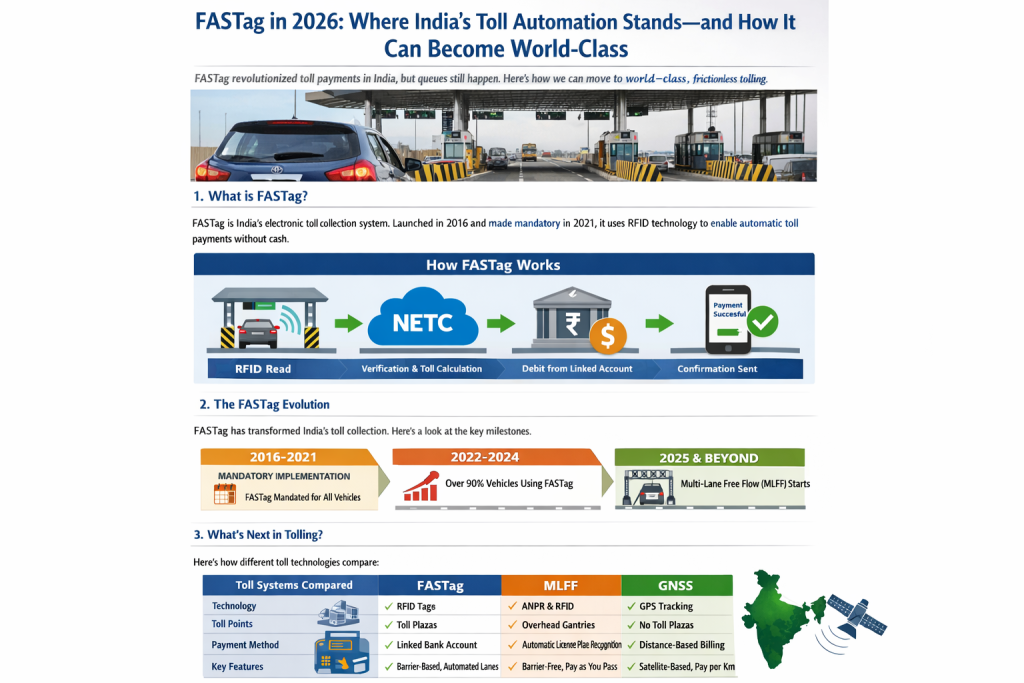
FASTag is India’s implementation of electronic toll collection using passive UHF RFID technology. The tag attached to a vehicle’s windshield contains a unique identifier. A roadside reader captures that identifier when the vehicle passes through a toll lane, and the transaction is associated with the vehicle’s registered account.
At a simplified level, the system looks like this:
Vehicle tag
    ↓
RFID reader and lane controller
    ↓
Toll plaza acquirer
    ↓
NETC transaction switch
    ↓
Issuer bank / FASTag wallet
    ↓
Debit, response, clearing and reconciliation
That diagram hides most of the operational complexity.
A real toll lane also needs:
- Antennas and RFID readers
- Lane cameras and ANPR systems
- Vehicle axle or classification sensors
- Traffic lights and barriers
- Local transaction storage
- Toll plaza servers
- Network connectivity, often through multiple providers
- UPS and generator backup
- Operator dashboards
- Fraud and exception rules
- Central transaction and reconciliation systems
The customer sees a green light, a beep and an SMS. Behind that experience is a distributed financial transaction system operating in a dusty, high-traffic, intermittently connected environment.
That is why FASTag should be evaluated as financial infrastructure plus roadside industrial IoT, not simply as a payment sticker.
What FASTag Automated Well
1. It reduced cash dependency
Cash toll collection creates predictable friction:
- Manual counting
- Change availability
- Receipt handling
- Human errors
- Queue formation
- Cash leakage risk
- Slower lane recovery after a failed transaction
FASTag converted much of that process into a machine-readable transaction. This improved auditability and reduced the number of manual interactions between drivers and toll operators.
2. It created a national interoperability layer
Before interoperable electronic tolling, drivers often faced different payment arrangements at different toll plazas. FASTag’s NETC framework created a common operating model where a tag issued by one participating bank could be used at toll plazas operated by another entity.
That separation between issuer and acquirer is important. Your bank or wallet provider does not need to operate the toll plaza. The toll plaza does not need to maintain a separate customer account for every vehicle. A central switching and clearing layer connects the participants.
This is the same basic architectural principle that makes card networks and interoperable payment systems scale.
3. It produced useful telemetry
Every toll event can potentially provide:
- Tag identifier
- Vehicle registration number
- Toll plaza and lane
- Timestamp
- Transaction amount
- Vehicle class
- Reader status
- Camera evidence
- Response code
- Exception reason
This data can improve traffic planning, toll plaza capacity decisions, highway maintenance prioritization and enforcement. However, collecting telemetry is not the same as using it well. The data needs common schemas, quality checks, privacy controls and reliable analytics pipelines.
How a FASTag Transaction Works End to End
Step 1: Tag detection
The RFID reader emits radio energy and listens for the passive tag response. The tag itself generally does not contain a battery. The reader identifies it as the vehicle enters the read zone.
This first step sounds simple, but the lane is a hostile RF environment. Performance can be affected by:
- Incorrect windshield placement
- Multiple tags in the same vehicle
- Metalized or damaged windshields
- Poor antenna alignment
- Nearby vehicles entering the read zone
- Reader interference
- Excessive vehicle speed
- Weather, dust and physical damage
A robust lane therefore cannot depend on RFID alone.
Step 2: Vehicle classification
The system must determine whether the vehicle is a car, light commercial vehicle, bus, truck or another supported category. Classification may use axle sensors, vehicle dimensions, cameras, operator input or a combination of systems.
This is one of the most important control points. A perfectly read tag with an incorrect vehicle class still produces an incorrect toll.
Step 3: Local lane decision
The lane controller checks whether the tag is recognized and whether the vehicle is eligible to pass. In a well-designed system, the roadside lane should not wait indefinitely for a distant central service.
The local system should have:
- A short-lived cache of valid tags
- Recent blacklist information
- Configurable risk rules
- Transaction sequence numbers
- Local store-and-forward capability
- A safe fallback mode
The lane needs to make a decision in milliseconds or a few hundred milliseconds, not after multiple unpredictable network round trips.
Step 4: NETC and issuer processing
The transaction travels through the toll plaza’s acquiring institution and the NETC ecosystem. The issuer bank or wallet provider validates the tag account and processes the debit or authorization.
This is where bank-specific differences become visible. Two FASTags may pass through the same toll lane but behave differently because their issuer systems have different:
- API response times
- Wallet balance policies
- Risk controls
- Retry mechanisms
- Maintenance windows
- Reconciliation processes
- Customer notification pipelines
Step 5: Clearing, confirmation and reconciliation
A toll transaction is not complete merely because the barrier opened. The ecosystem must later reconcile:
- What the lane recorded
- What the acquirer submitted
- What the issuer accepted
- What was debited
- What was eventually settled
- Whether the customer was charged once or more than once
This is where delayed SMS messages and duplicate-looking transactions often originate. The customer-facing notification may be asynchronous, while the lane decision was already completed.
The Real Bottlenecks in FASTag Architecture
1. Bank and wallet fragmentation
FASTag is interoperable from the driver’s perspective, but the backend experience remains fragmented.
Different issuers may expose different customer journeys for:
- Recharge
- Low-balance alerts
- Tag activation
- Vehicle registration updates
- Refunds
- Disputes
- Replacement tags
- Blacklist removal
- Failed transaction handling
A driver does not care which bank’s internal queue failed. They only know that the toll barrier did not open.
This fragmentation also makes incident diagnosis difficult. The toll operator may see a decline code, the bank may see a timeout, and the customer may see no useful message at all.
A world-class system needs a standard error vocabulary with actionable explanations:
| Current-style message | Better operational message |
|---|---|
| Transaction failed | Issuer response timed out after 2.5 seconds |
| Tag blacklisted | Account status last synchronized at 10:42:18 IST |
| Insufficient balance | Available balance ₹X; minimum required ₹Y |
| Invalid vehicle | Tag registration and vehicle number do not match |
| Try again | Lane is in offline fallback mode; transaction will reconcile automatically |
Error messages are not cosmetic. They reduce support volume and prevent drivers from making unsafe decisions in a live traffic lane.
2. NPCI clearing and asynchronous confirmation
A toll transaction may involve several timestamps:
- RFID read time
- Local lane acceptance time
- Acquirer submission time
- Issuer authorization time
- Debit time
- Clearing time
- Customer notification time
These timestamps can differ significantly.
A central switch or clearing system can be highly reliable while the overall user experience still feels slow because one downstream issuer is delayed. The correct architectural response is not to make the lane wait forever. It is to separate:
- Operational authorization
- Financial finality
- Customer notification
- Settlement and reconciliation
The lane should be optimized for safe traffic movement. Financial settlement can happen through controlled asynchronous workflows, provided the system has strong idempotency and fraud controls.
Every transaction should carry a globally unique identifier. Retries must be safe. If a network request times out after the issuer debits the wallet, replaying the same request must not create a second debit.
A timeout is not the same as a failure
3. Blacklist synchronization delays
Blacklist status is one of the most visible FASTag problems for drivers.
An account may be blocked because of:
- Insufficient balance
- KYC or account issues
- Vehicle-tag mismatch
- Suspected misuse
- Multiple failed debits
- Administrative restrictions
- A previous transaction dispute
The operational difficulty is synchronization. If the issuer updates the tag status centrally but the toll plaza’s local cache is stale, the lane may incorrectly reject or accept the vehicle.
This is a classic distributed-systems problem involving:
- Event propagation
- Cache expiry
- Message delivery
- Retry queues
- Clock synchronization
- Conflict resolution
- Eventual consistency
For a tolling system, eventual consistency must have an explicit safety model. A blacklist event should propagate quickly, but a temporary failure in the blacklist feed should not bring every lane to a standstill.
A better design would include:
- Signed status events
- Version numbers for every tag state
- Sequence-aware updates
- Acknowledgement from toll plaza gateways
- Dead-letter queues for failed updates
- Monitoring for stale caches
- A maximum permitted cache age
- Clear fail-open and fail-closed rules by risk category
A simple operational dashboard should show the percentage of toll lanes running with blacklist data older than 30, 60 or 300 seconds. Without that metric, operators are managing a blind spot.
4. Connectivity and power at toll plazas
A toll plaza is not always sitting inside a high-quality data centre. It may be located on an isolated highway stretch with:
- Single-provider connectivity
- High packet loss
- Variable mobile backhaul
- Power fluctuations
- Generator dependency
- Damaged underground cabling
- Poor equipment-room cooling
India’s highway network is geographically enormous. Designing as if every toll lane has stable fibre and low-latency connectivity is an architectural mistake.
Each plaza should have genuine multi-path resilience:
- Primary wired connection
- Independent secondary provider
- 4G or 5G failover
- Local transaction queue
- Store-and-forward encryption
- Battery backup for networking and lane equipment
- Periodic disaster-recovery drills
Design the lane for degraded mode
RFID Is Valuable—but It Has a Physical Ceiling
RFID is inexpensive, fast and already deployed at national scale. Replacing it overnight would be impractical and financially wasteful.
However, RFID has inherent constraints:
- It identifies a tag, not necessarily the actual vehicle
- It depends on correct installation
- It can suffer from read collisions
- It does not naturally measure distance travelled
- It can be abused through tag swapping or cloning
- It requires roadside equipment at defined toll points
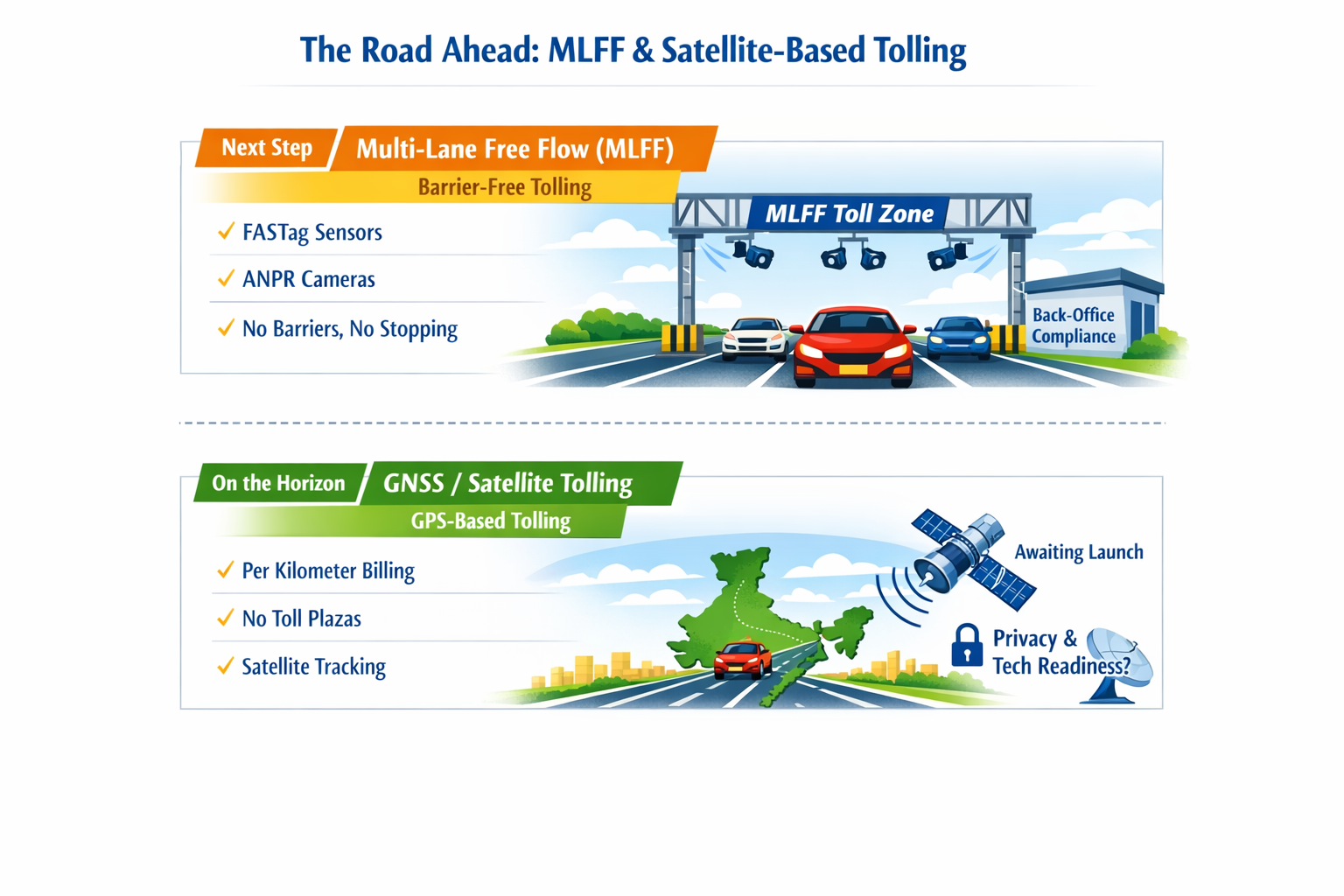
That means FASTag should evolve into a multi-sensor tolling platform.
The strongest architecture combines:
- RFID for fast lane-level identification
- ANPR for vehicle-number verification
- Cameras for evidence
- Axle and dimension sensors for classification
- Central analytics for anomaly detection
- GNSS for future distance-based charging
If the RFID identity and number plate disagree, the system should not automatically punish the driver. It should place the event into a risk-based exception workflow with evidence and appeal mechanisms.
GPS/GNSS-Based Tolling: The 2026 Transition
The next major direction is satellite-based tolling using GPS/GNSS positioning. Instead of charging only when a vehicle crosses a physical toll plaza, the system can calculate the distance travelled on a tolled road segment.
This could improve highway convenience because drivers would not necessarily need to slow down at every toll point. It may also support more precise charging models for:
- Long corridors
- Ring roads
- Access-controlled expressways
- Distance-based commercial transport
- Congestion-sensitive routes
But GNSS tolling is not a simple replacement for FASTag.
The technical challenges
GNSS accuracy varies because of:
- Urban canyon effects
- Tunnels
- Dense tree cover
- Multipath reflections
- Weak satellite visibility
- Device quality
- Jamming or spoofing
- Delayed location uploads
A vehicle location is also sensitive personal and operational data. The system must define:
- How much location is collected
- How long it is retained
- Who can access it
- How disputes are handled
- What happens when the device is offline
- How the system distinguishes a tolled road from a parallel service road
The most practical transition is likely to be phased:
- RFID remains the default payment rail
- GNSS pilots operate on selected corridors
- RFID, ANPR and GNSS cross-validate each other
- Distance calculation is audited against map and sensor data
- Drivers receive transparent trip-level statements
- Dispute and correction processes mature before wider rollout
GNSS should not become a black box that silently charges a driver based on an opaque route calculation.
How to Build a World-Class Highway Tolling System
1. Define measurable service-level objectives
The system needs public and operator-facing targets, such as:
- Lane decision latency
- Reader success rate
- Duplicate transaction rate
- Blacklist propagation delay
- Issuer timeout rate
- Reconciliation completion time
- Refund turnaround time
- Plaza network availability
- ANPR and RFID mismatch rate
What gets measured gets improved. “FASTag is working” is too vague to operate a national platform.
2. Use an event-driven architecture
Every important action should generate a durable event:
TagDetected
VehicleClassified
LaneAuthorized
DebitRequested
DebitConfirmed
DebitTimedOut
BlacklistUpdated
ReconciliationCompleted
DisputeRaised
RefundProcessed
An event-driven model improves traceability and makes retries, audits and analytics easier. It also allows operators to reconstruct what happened during a disputed toll.
3. Make every payment operation idempotent
The transaction key should remain stable across retries. The issuer must be able to answer:
“Have I already processed this exact toll event?”
This single control prevents a large class of duplicate-debit problems.
4. Build a unified dispute experience
Drivers should not be forced to identify whether the toll operator, issuer bank, acquiring bank or central switch caused the problem.
A single complaint reference should follow the transaction across the ecosystem. The backend can route the issue to the correct participant, but the customer should have one visible workflow.
5. Use privacy-preserving analytics
Highway telemetry is valuable, but it should not become uncontrolled surveillance. Data collection should follow:
- Purpose limitation
- Data minimization
- Encryption in transit and at rest
- Role-based access
- Retention schedules
- Tamper-evident audit logs
- Aggregated reporting wherever individual identity is unnecessary
6. Engineer for Indian field conditions
A world-class design is not only about cloud architecture. It must survive:
- Heat and dust
- Monsoon water ingress
- Power interruptions
- Fibre cuts
- Inconsistent maintenance
- High axle loads and vibration
- Local traffic surges
- Remote roadside locations
The best tolling system is the one that continues to behave predictably when the environment is least predictable.
The Convenience Layer Matters as Much as the Payment Layer
Highway convenience is not limited to an automatic debit. A good FASTag experience should include:
- Reliable low-balance alerts before a trip
- One-tap recharge and autopay
- Clear toll history
- Accurate estimated charges
- Fast tag replacement
- Simple vehicle transfer procedures
- Immediate confirmation of blacklist removal
- Receipts that show plaza, time, vehicle class and amount
- A functional helpline with transaction-level visibility
Drivers should not have to stop at a toll plaza to discover that their tag was blocked three days earlier.
The broader opportunity is to turn FASTag into a trusted mobility identity layer—without making it an uncontrolled identity database. Tolling, parking, fuel payments, fleet management and road-user services could eventually interoperate, but only with strong consent and governance.
Final Assessment
FASTag is a significant digital public infrastructure achievement. It has reduced cash dependence, created a common electronic tolling framework and generated the operational data needed to modernize highway management.
Its next phase requires more than additional RFID readers.
India needs:
- Better issuer-bank standardization
- Faster status propagation
- Local-first lane architecture
- Idempotent clearing and reconciliation
- Multi-provider connectivity
- Strong ANPR and RFID cross-validation
- Transparent customer disputes
- Privacy-preserving telemetry
- Carefully governed GNSS pilots
- Public performance metrics
The long-term goal should not be merely “cashless tolling”. It should be predictable, evidence-based, interoperable road-use charging where the vehicle moves
1-on-1 Web Architecture & Performance Deep Dive
60-Minute Intensive Architecture, Speed & Security Review • 60 Minutes
- Full LEMP / Cloudflare Edge / WordPress performance inspection
- Identification of TTFB, caching & database query bottlenecks
- Custom architectural action plan & written remediation blueprint
Direct calendar scheduling & secure payment link via Razorpay.